Casino Merchant Account Netherlands

Are you an online casino platform owner and looking for a reliable payment processing solution for your online casino business in the Netherlands? Look no further than WebPays’ Casino Merchant Account Netherlands.

As an online casino merchant, you face unique challenges when it comes to payment processing. Traditional payment processors may be hesitant to work with online casinos due to the high-risk nature of the industry. However, with WebPays’ casino merchant account, you can rest assured that your payment processing needs will be met with ease and efficiency.

Benefits of Choosing WebPays’s Casino Merchant Account

Here are some of the top benefits of choosing WebPays’ Casino Merchant Account Netherlands:

  1. Global reach: With WebPays’ casino merchant account, you can accept payments from customers all over the world. We support 100+ international currencies, enabling you to accept payments in the currency of your choice.
  2. Alternative payment options: Our Casino Payment Gateway Netherlands supports 35+ payment options, including credit and debit cards, digital wallets, ACH transfers, digital currencies, and bank transfers. This means that your customers can choose the payment option that is most convenient for them, increasing the likelihood of successful transactions.
  3. Secure payment processing: We understand that security is of the utmost importance when it comes to payment processing for online casinos. That’s why we use advanced fraud prevention tools, including 3D Secure, tokenization, AVS & CVV checkers, and fraud scoring, to prevent fraudulent transactions from occurring.
  4. User-friendly platform: Our payment platform is designed to be user-friendly and easy to navigate, making it easy for you to manage your payments and transactions.
  5. Customized solutions: At WebPays, we understand that each online casino business has unique needs. That’s why we offer customized payment processing solutions tailored to meet the specific needs of your business.
  6. Dedicated support: We offer 24/7 support to our casino payment gateway holders in the Netherlands. If you have any questions or need assistance, our team of professionals is always here to help.

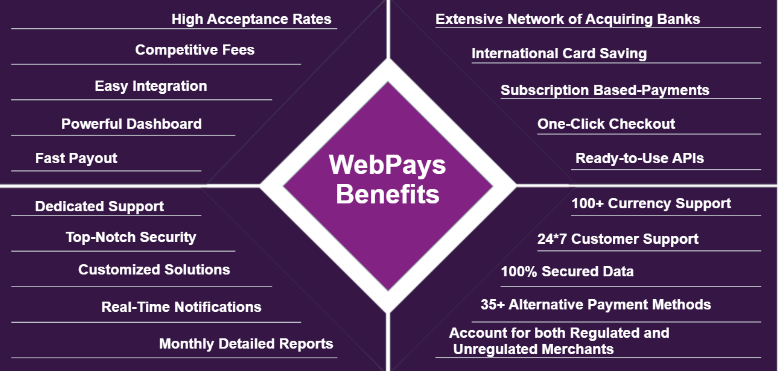
Furthermore, WebPays’ Online Casino Payment Processing Netherlands has hundreds of features that were only created to help merchants expand their customer bases and revenues. Here in the below image, we have highlighted some of the top benefits of acquiring WebPays as your payment partner:
How does WebPays’ Casino Merchant Account work?

Here’s how WebPays’ casino merchant account works:

  1. Apply for an account: The first step is to apply for a casino merchant account with WebPays. Our application process is simple and straightforward, and our team will work with you every step of the way to ensure a seamless application process.
  2. Integration: Once your application has been approved, we will work with you to integrate our payment gateway with your existing platform.
  3. Accept payments: Once your payment gateway has been integrated, you can start accepting payments from customers all over the world. Our payment gateway supports a wide range of payment options, including credit and debit cards, e-wallets, and bank transfers.
  4. Manage transactions: Our user-friendly platform makes it easy for you to manage your payments and transactions. We provide a powerful dashboard to view transaction histories, issue refunds, and more. Plus, you can download daily transaction reports and monthly reports and also analyze or compare the previous reports.

Conclusion

In conclusion, if you’re in the online casino business in the Netherlands, WebPays’ casino merchant account is the perfect payment processing solution for your business. With our global reach, secure payment processing, user-friendly platform, customized solutions, and dedicated support, you can rest assured that your payment processing needs will be met with ease and efficiency. Apply for a casino merchant account with WebPays today and take your online casino business to the next level!

Frequently Asked Questions (FAQs)

Q: Is WebPays’ payment gateway compatible with my online casino platform?

A: WebPays’ payment gateway is compatible with a wide range of online casino platforms. To ensure a smooth integration process, our team of professionals will work with you.

Q: How does WebPays prevent fraudulent transactions?

A: We use advanced fraud prevention tools, including encryption, tokenization, 3D Secure authentication, SSL, AVS & CVV checkers, and fraud scoring, to prevent fraudulent transactions from occurring.

Q: How long does it take to set up a casino merchant account with WebPays?

A: Our application process is simple and straightforward, and our team will work with you every step of the way to ensure a seamless application process. The exact timeline for setting up your account will depend on your specific needs and requirements.

Q: Is there a limit to the amount of transactions I can process with WebPays’ payment gateway?

A: No, there is no limit to the amount of transactions you can process with our payment gateway. We are equipped to handle high-volume transactions with ease and efficiency.

Q: Does WebPays provide support for casino merchant account holders?

A: Yes, we offer 24/7 support to our casino merchant account holders. If you have any questions or need assistance, our team of professionals is always here to help.

Q: What fees does WebPays charge for its payment processing services?

A: Our fees are transparent and competitive, and we work with each of our clients to tailor our pricing to meet their specific needs and requirements.

Q: Is WebPays compliant with industry regulations and standards?

A: Yes, we are fully compliant with industry regulations and standards, including PCI-DSS and GDPR.

Q: Can I customize my payment processing solution with WebPays?

A: Yes, we offer customized payment processing solutions tailored to meet the specific needs of your online casino business.

Q: Is my data secure with WebPays?

A: Yes, we take data security seriously and use advanced encryption and security measures to protect your data and transactions.

Q: How do I sign up for your online casino payment solutions?

A: Signing up for our online casino payment solutions is easy. Visit our website and fill out the “apply now form”. Our experts will examine your application and get back to you within the next 24 hours.

Q: What documents will be needed?

A: Please have the following documents available so that your application can be processed quickly:

  1. Complete details of your business
  2. Website or App of your business
  3. Contact Information, such as email, phone number, and address
  4. Details of the business owner
  5. Address proof of owner and business
  6. Documents of business partnership
  7. Last three months’ business bank statement

A Guide to eCommerce Payment Gateway

eCommerce has grown exponentially in the last decade and is showing no signs of slowing down. With the rise of online shopping, digital payments, and mobile commerce, eCommerce has become a critical aspect of the global economy.

It has become an essential part of our daily lives, revolutionizing the way we shop and conduct business. According to recent statistics, eCommerce sales are continuously growing year over year. In Europe alone, eCommerce sales increased by 14.2% in 2020 compared to the previous year, reaching a total of €717 billion.

The COVID-19 pandemic has further accelerated the growth of eCommerce as people have turned to online shopping to avoid physical contact and adhere to social distancing guidelines. The pandemic has also changed the way people shop, with a significant increase in online grocery shopping, digital entertainment, and home goods. More people are turning to online shopping as a safer alternative to in-store shopping. In fact, according to Digital Commerce 360, eCommerce sales in the US grew by 44% in 2020, with online sales accounting for 21.3% of total retail sales.

This trend is expected to continue in the coming years, with projections showing that eCommerce sales in Europe will reach €1 trillion by 2024. This growth is mainly driven by the increasing number of online shoppers, improved online shopping experiences, and the convenience of online payments.

The future potential of eCommerce is immense, with more consumers worldwide gaining access to the internet and mobile devices. With this rapid growth, eCommerce payment gateways have become an essential component of online businesses. They provide a secure and reliable payment processing system, enabling businesses to accept payments from customers worldwide. In the next sections, we will discuss eCommerce payment gateways in more detail and how they work.

What is an eCommerce Payment Gateway?

An eCommerce payment gateway is a service that allows online merchants to securely accept and process electronic payments from their customers. It acts as a middleman between the merchant’s website and the bank that processes the payment, encrypting sensitive information to ensure that transactions are safe and secure. Essentially, a payment gateway facilitates the transfer of money from the customer’s account to the merchant’s account in a fast and secure manner.

Need for an eCommerce payment gateway

In today’s digital era, eCommerce has become an essential part of our lives. Online shopping has become more prevalent than ever, and it’s not just limited to a specific region or country, but rather a global phenomenon. As a result, the need for secure and reliable payment methods has become increasingly important. That’s where eCommerce payment gateways come in.

eCommerce payment gateways provide a secure platform for merchants to accept online payments from customers. With the rise of online shopping, payment gateways have become an integral part of the eCommerce ecosystem. Without payment gateways, online transactions would be significantly more challenging to manage, and the risk of fraud and chargebacks would be much higher.

Payment gateways offer a secure, efficient, and convenient way for customers to pay for their purchases. They allow merchants to accept payments through multiple channels, including credit and debit cards, e-wallets, bank transfers, and other alternative payment methods. Payment gateways also help in reducing the complexity of payment processing, enabling merchants to focus on growing their businesses.

Additionally, payment gateways often provide merchants with a range of tools and features to help them manage and analyze their transactions, such as real-time reporting, customizable payment forms, and recurring billing options.

Overall, payment gateways play a crucial role in the growth and success of eCommerce businesses in the digital era. They provide a secure and reliable payment platform for both merchants and customers and without them, the eCommerce landscape would be significantly more challenging to navigate.

How does an eCommerce payment gateway work?

Here are the steps involved in the functioning of an eCommerce payment gateway:

Customer places an order: The customer selects the desired products/services from the eCommerce website and adds them to the shopping cart. After reviewing the cart, the customer proceeds to checkout.

Entering Payment Information: At the checkout page, customers are prompted to enter their payment information, such as credit/debit card details, bank account details, or any other payment mode they prefer.

Encryption of Payment Details: The payment gateway encrypts the customer’s payment details, ensuring the data is safe and secure during transmission.

Authorization Request: The payment gateway sends an authorization request to the customer’s bank/payment processor for verification of the transaction details and availability of funds.

Response from Bank/Processor: The customer’s bank/payment processor responds to the authorization request with either an approval or a decline.

Transaction Confirmation: If the authorization is approved, the payment gateway confirms the transaction and sends a message to the eCommerce platform indicating the successful transaction.

Settlement: The funds from the customer’s account are transferred to the merchant’s account through a settlement process.

Notification to the customer: The payment gateway sends a notification to the customer confirming the successful transaction and may also send an invoice or receipt for the purchase.

Overall, the eCommerce payment gateway acts as a secure intermediary between the customer and the merchant, facilitating the transaction process and ensuring that sensitive payment information is protected.

Types of eCommerce payment gateways

There are several types of payment gateways available for eCommerce businesses. Each type has a unique set of benefits and drawbacks. Here are some of the most common types of payment gateways:

Hosted Payment Gateways: Hosted payment gateways redirect customers to the payment page of the service provider. This type of gateway is easy to set up, as the service provider takes care of security and compliance. The main disadvantage is that the customer is taken away from the merchant’s site, which can reduce conversions.

Self-Hosted Payment Gateways: Self-hosted payment gateways are integrated into the merchant’s website, which gives customers a seamless checkout experience. Merchants have greater control over the design and branding of the checkout page. However, merchants must take care of security and compliance, which can be time-consuming.

API Payment Gateways: API payment gateways integrate directly with the merchant’s website, providing a completely customizable checkout experience. This type of gateway offers the most control and flexibility but requires technical knowledge and resources to implement.

Mobile Payment Gateways: Mobile payment gateways are designed specifically for mobile devices, allowing customers to pay using their smartphones or tablets. This type of gateway can increase conversions for mobile users, but may not be suitable for all types of products or services.

Each type of payment gateway has its own set of advantages and disadvantages, so it’s important to choose the right one for your business based on your needs and resources.

The benefits of using an eCommerce payment gateway for your business

Using an eCommerce merchant account and payment gateway can provide several benefits for your business, including:

Increased Sales: By accepting a wide range of payment options, you can appeal to a broader customer base, leading to increased sales.

Improved Security: eCommerce payment gateways are designed to protect both the customer’s payment information and the merchant’s data. This added security helps to build trust with customers, which can lead to repeat business.

Faster Transactions: Payment gateways can process transactions quickly, reducing wait times for customers and allowing businesses to receive payments more efficiently.

Better Record Keeping: Payment gateways automatically record and organize transaction data, making it easier for businesses to track their finances and generate reports.

International Reach: eCommerce payment gateways allow businesses to sell to customers globally, regardless of their location or currency.

Reduced Risk: Payment gateways help to minimize the risk of fraud, chargebacks, and other payment-related issues, giving businesses greater peace of mind.

Increased Convenience: Payment gateways provide customers with a convenient and seamless payment experience, improving their overall shopping experience and increasing the likelihood of repeat business.

Conclusion

In conclusion, an eCommerce payment gateway is a crucial component for any online business looking to accept payments from customers worldwide. With so many options available in the market, it is essential to choose a payment gateway provider that caters to the specific needs of your business. In this guide, we have discussed the various types of payment gateways, their pros and cons, and the factors to consider when choosing an ideal payment gateway.

Out of the top eCommerce payment gateway providers, we highly recommend WebPays due to its advanced security features, cost-effective pricing, multiple payment options, easy integration, and excellent customer support. With WebPays, you can rest assured that your business’s payment processing needs are in safe and reliable hands. So, choose WebPays and take your online business to new heights of success.

A Guide for Offshore Payment Processing

Offshore payment processing has become increasingly important for businesses that operate across borders. As the world becomes more interconnected, businesses are expanding their reach beyond their home countries and tapping into global markets. However, accepting payments from customers in different countries can be a complex and costly process.

In this guide, we will provide a comprehensive overview of offshore payment gateways, including what they are, why they are essential for cross-border businesses, and how businesses can choose the right offshore payment processor for their needs. We will also highlight some of the most popular offshore payment processors and explain why WebPays is the best offshore payment processor for businesses.

What is Offshore Payment Processing?

Offshore payment processing refers to the process of accepting payments from customers located in different countries through an offshore payment gateway that is located outside of the merchant’s home country. Offshore payment processing is often used by businesses that operate in countries with restrictive payment processing regulations or by businesses that want to take advantage of lower transaction fees and other benefits that are available in other countries. Payment gateways and merchant accounts are the two essential payment processing services a merchant needs to accept online payments. Let’s have a glimpse at both of them.

What is an Offshore Payment Gateway?

An offshore payment gateway is a platform that facilitates online payment transactions from customers located in different countries. Offshore payment gateways are typically provided by payment processors that are based in other countries. The payment gateway acts as a bridge between the merchant’s website or application and the payment processor, securely transmitting payment information and authorizing transactions.

What is an Offshore Merchant Account?

An offshore merchant account is a bank account that is established in a foreign country by a merchant who wants to accept payments from customers located in that country. An offshore merchant account allows merchants to process payments in the currency of the foreign country, which can help to reduce transaction fees and increase revenue. Offshore merchant accounts are often used by businesses that operate in countries with restrictive payment processing regulations or by businesses that want to take advantage of lower transaction fees and other benefits that are available in other countries.

Why is Offshore Payment Processing Essential for Cross-Border Businesses?

Offshore payment processing is essential for cross-border businesses for several reasons:

Access to More Payment Methods: It typically supports a wider range of payment methods than domestic payment processors, which can help businesses to attract customers in different countries and increase revenue. By supporting international payment methods such as international credit cards, e-wallets, cryptocurrencies, ACH transfers, and wire transfers, an offshore payment gateway helps you generate higher revenue.

Reduced Transaction Fees: Offshore payment processors often offer lower transaction fees than domestic payment processors, which can help businesses to save money on payment processing costs.

Currency Conversion: Offshore payment processors often offer currency conversion services, allowing businesses to accept payments in multiple currencies and reducing the risk of exchange rate fluctuations.

Compliance: Offshore payment processors are often subject to less stringent regulations than domestic payment processors, which can make it easier for businesses to comply with local regulations.

How Does Offshore Payment Processing Help Merchants Grow Their Businesses?

Offshore payment processing can help merchants expand their businesses in several ways:

Increased Global Reach: By accepting payments from customers in different countries, businesses can expand their customer base and increase revenue.

Reduced Payment Processing Costs: Offshore payment processors (OPP) often offer lower transaction fees than domestic payment processors, which can help businesses to save money on payment processing costs.

Enhanced Customer Experience: OPP typically support a wider range of payment methods than domestic payment processors, which can help businesses to provide a better customer experience and attract more customers.

Enhanced Security: It provides robust security features and fraud prevention tools to protect merchants and their customers from fraudulent transactions.

Customizable Features: It offers customizable features and tools that can be tailored to meet the specific needs of individual businesses, helping them to optimize their payment processing and increase revenue.

Scalability: Offshore merchant accounts are often designed to support businesses of all sizes, from small startups to large enterprises. This scalability can help businesses to grow and expand without having to worry about outgrowing their payment processing system.

Flexibility: They often offer flexible payment options, such as recurring payments, installment payments, and subscriptions, which can help businesses to offer more payment options to their customers and increase revenue.

Things to Consider When Choosing an Offshore Payment Processing Firm

Choosing the right offshore payment processing firm can be a challenging task, given the wide range of options available in the market. Some of the factors that businesses should consider when choosing an offshore payment processing firm include:

Reputation: Look for a payment processing firm with a good reputation for reliability and security. Research the company’s history, customer reviews, and security measures to ensure that it is a trustworthy partner.

Supported Payment Methods: Ensure that the payment processing firm supports the payment methods that are most commonly used in the countries where the business operates. This can help to increase revenue and customer satisfaction.

Transaction Fees: Compare transaction fees across different payment processing firms to ensure that the fees are reasonable and cost-effective for the business.

Currency Conversion: If the business operates in multiple countries, ensure that the payment processing firm offers currency conversion services to reduce the risk of exchange rate fluctuations.

Compliance: Ensure that the payment processing firm is compliant with all relevant regulations in the countries where the business operates, to avoid any legal issues or penalties.

Top-notch Security: Ensure that the PSP you choose should be PCI-DSS compliant. It should offer top-notch security measures such as encryption, tokenization, 3D secure authentication, AVS and CVV checkers, and fraud scoring to safeguard its merchants and their customers. Also, it should provide futuristic chargeback prevention tools to eliminate potential chargeback fraud.

Popular Offshore Payment Processors

There are several popular offshore payment processors that businesses can consider when looking for a payment processing solution. Some of the most popular offshore payment processors include:

PayPal: Many people use PayPal, which is a payment processor that supports transactions in multiple currencies and countries. It offers a range of payment options, including credit and debit cards, bank transfers, and PayPal balance transfers.

Stripe: Stripe is a payment processing platform that supports transactions in over 135 currencies and over 40 countries. It also offers various payment options, including credit and debit cards, Apple Pay, e-wallets, and Google Pay.

Worldpay: Worldpay is a payment processing firm that supports transactions in over 146 countries and 120 currencies. It offers various payment options, including credit or debit cards, digital wallets, and bank transfers.

WebPays: WebPays is the best offshore payment processor in Europe, especially in the Netherlands and the UK. WebPays’ customer-first policy keeps it one step ahead of its opponents. They are dedicated to providing state-of-the-art payment solutions to all high-risk businesses. We recommend you choose WebPays; let’s see why it is the best.

Why is WebPays the Best Offshore Payment Processor?

WebPays is the best offshore payment processor for businesses for several reasons:

Wide Range of Payment Options: WebPays supports a wide range of payment options, including credit and debit cards, e-wallets, digital currencies, and bank transfers, making it easy for businesses to accept payments from clients in different countries.

Multiple Currency Support: WebPays supports transactions in 100+ international currencies, allowing businesses to accept payments in the currency of their customers’ countries and reducing the risk of exchange rate fluctuations.

Competitive Transaction Fees: WebPays offers competitive transaction fees that are cost-effective for businesses of all sizes. Plus, it has transparent pricing with no hidden charges.

Secure Payment Processing: WebPays uses advanced security features and fraud prevention tools to protect merchants and their customers from fraudulent transactions. It also uses advanced AI to eradicate potential fraud.

Compliance: WebPays is compliant with all relevant regulations in the countries where it operates, ensuring that businesses can operate legally and avoid any legal issues or penalties. Also, it has all payment security compliances, such as PCI-DSS and GDPR.

Furthermore, WebPays provides hundreds of benefits to its merchants. It also provides payment services to unregulated merchants so they do not suffer due to a lack of rules and regulations.

Conclusion

Offshore payment processing is a crucial component of international business operations. It enables businesses to expand their reach, increase revenue, and reduce payment processing costs. Offshore payment gateways and merchant accounts provide businesses with the flexibility, scalability, and security they need to process cross-border transactions. When choosing an offshore payment processing firm, businesses should consider factors such as reputation, supported payment methods, transaction fees, currency conversion, and compliance. Businesses can access new markets, increase revenue, and improve customer satisfaction by choosing the right offshore payment processor. As the best offshore payment processor, WebPays is the ideal partner for businesses looking to expand their operations globally.

High-Risk Payment Solutions

Are you tired of getting rejected by traditional payment processors due to the high-risk nature of your business? We have the answer for you, so look no further. Our high-risk payment solutions are designed to help businesses like yours process online transactions safely and efficiently without fear of being shut down or penalized.

Our high-risk payment gateway comes with state-of-the-art fraud protection measures and risk management tools to ensure that your business and customers are always protected. With our reliable payment gateway, you can accept payments from customers all over the world, without worrying about chargebacks, fraud, or payment declines.

At WebPays, we understand the challenges that high-risk businesses face when it comes to payment processing. That’s why we have developed payment solutions specifically tailored to high-risk businesses’ needs. With our high-risk merchant account and payment gateway, you can streamline your payment processes, reduce your processing costs, and increase your revenue.

Don’t let your high-risk status hold you back. Acquire WebPays’ high-risk payment services today and take your business to new heights. Our team of professionals is always ready to help you with any queries or concerns you may have. Contact us today to learn more about our payment solutions and how they can benefit your business. Meanwhile, in the blog, we will cover the concept of high-risk businesses and the features a high-risk payment processor must possess in its solutions.

What are High-risk Businesses, and Why are They Considered High-risk?

High-risk businesses refer to companies that are more likely to experience financial losses or legal problems due to a higher level of risk associated with their industry, business model, or customer base. These businesses are considered high-risk by banks, financial institutions and payment processors because of the potential for fraud, chargebacks, and other financial risks.
Some examples of high-risk businesses include:

High-risk Businesses

Adult entertainment
Online gambling (casinos, betting, etc.)
Online gaming
Forex trading
Escort services
Online marketplaces
E-cigarettes, Vape and Tabacco
Subscription-based services

The reasons why these businesses are considered high-risk vary, but common factors include the following:

Why High-risk?

High rate of chargebacks and fraud
High-volume transactions
Multi-currency and Multi-payment modes
Location (region or country) of the business
Industry regulation and legal compliance
The potential for reputational damage
Uncertain or volatile revenue streams
High potential for money laundering or illegal activity
Higher rates of customer disputes or complaints

Because of the higher risk, these businesses may face challenges when acquiring merchant accounts and other payment processing services from financial institutions. They may also face higher fees or stricter requirements for processing payments.

What are High-risk Payment Solutions?

High-risk payment solutions are specialized payment processing services designed for businesses that operate in high-risk industries or have a higher risk of financial loss. Examples of high-risk payment solutions include high-risk merchant accounts, payment gateways, credit card processing, etc., which allow businesses to accept credit and debit card payments and alternative payment methods such as e-wallets and digital currencies.

These solutions are typically offered by payment processors or financial institutions that specialize in serving high-risk businesses. These high-risk payment solutions are designed to mitigate the risks associated with processing payments for high-risk businesses. They typically include features such as:
Fraud detection and prevention tools to minimize the risk of chargebacks and fraudulent transactions
Chargeback management and dispute resolution services to help businesses resolve customer disputes and minimize financial losses
Customized underwriting processes to assess the risk associated with each business and determine appropriate processing fees and terms
Flexible payment options to meet the unique needs of high-risk businesses, such as high-volume processing, recurring billing, and international payments
Alternative payment methods and multi-currency acceptance in order to accept global customer payments.
Compliance management services to help businesses stay up-to-date with regulatory requirements and minimize legal risks.

It’s important for businesses in high-risk industries to work with a payment processor like WebPays that understands their unique needs and has experience serving similar businesses. This can help them minimize the risk of financial losses and regulatory issues, while also providing the flexibility and convenience of accepting electronic payments. Moreover, a high-risk business can be unregulated in some places, so a high-risk acquirer should also be ready to serve these unregulated services.

Conclusion

In conclusion, we know that high-risk businesses face unique challenges when it comes to payment processing due to their higher risk of financial loss or legal issues. However, specialized high-risk payment solutions like those offered by WebPays can help these businesses process online transactions safely and efficiently. With state-of-the-art fraud protection measures, risk management tools, and compliance management services, high-risk payment solutions provide the flexibility and convenience of accepting electronic payments while minimizing the risks associated with processing payments for high-risk businesses. It’s important for high-risk businesses to work with payment processors like WebPays that understand their unique needs and have experience serving similar businesses, so they can streamline their payment processes, reduce their processing costs, and increase their revenue without fear of being shut down or penalized. At last, we suggest you choose WebPays as your payment partner for a hassle-free payment experience.

Global Payment Gateway Has Become a Necessity in this World of the Online Market

The rise of the internet has transformed the world of commerce, providing businesses with the ability to reach customers globally. The online marketplace has become increasingly competitive, and as such, businesses must adapt to stay relevant. One critical aspect of this adaptation is the ability to facilitate online transactions seamlessly. This is where a global payment gateway becomes a necessity. In this blog, we will explore how a global payment gateway has become essential in the world of the online market, global trade overview, and the potential for further growth of global trade facilitated by global payment gateways.

What is a Global Payment Gateway?

A global payment gateway is a technology that facilitates electronic payments across multiple currencies and countries. It enables businesses to accept online payments from customers worldwide, providing a secure and efficient transaction process. A global payment gateway acts as an intermediary between the merchant and the acquiring bank, handling the authorization and settlement of online transactions. With this, businesses can expand their customer base and sell products or services to customers across the globe.

Global Trade Overview

Global trade has been growing steadily over the past few years, driven by advancements in technology and increasing globalization. According to the United Nations Conference on Trade and Development (UNCTAD), the value of global trade hit an all-time high of $32 trillion which is a great sign of continuously rising international trade.

The Potential for Further Growth of Global Trade

The potential for further growth of global trade is enormous, with many emerging economies becoming more integrated into the global economy. The rise of e-commerce has also made it easier for businesses to access new markets and expand their customer base. According to a report by the United Nations Conference on Trade and Development (UNCTAD), e-commerce sales are expected to reach $4.9 trillion in 2023, up from $3.9 trillion in 2020. This growth in e-commerce is driving the need for efficient and secure online payment systems that can handle transactions across multiple currencies and countries.

How a Global Payment Gateway is Helping Grow World Trade

A global payment gateway is essential in facilitating cross-border transactions and enabling businesses to reach customers globally. By providing a secure and efficient payment system, global payment gateways have become a critical component in the growth of e-commerce and global trade. They enable businesses to accept payments from customers worldwide, without the need for a physical presence in each country. With a global payment gateway, businesses can expand their customer base and increase revenue, driving economic growth and creating new opportunities.

Conclusion

In conclusion, the online marketplace is growing rapidly, and businesses must adapt to stay relevant. A global payment gateway is essential in facilitating cross-border transactions and enabling businesses to reach customers globally. With the potential for further growth of global trade, the importance of global payment gateways is likely to increase. Businesses that embrace global payment gateways can increase their customer base, drive economic growth, and create new opportunities. There are many payment service providers, but WebPays is what a merchant needs, a complete pack of all solutions.

About WebPays

We are experts in the payments industry who build secure payment solutions and offer constant support to assist you in boosting your sales. WebPays aims to be the first choice for merchants when they require payment solutions. We provide the most reliable and trustworthy payment solutions to help your business grow. We expand the clientele of your business and take care of a lot more.

Obtain the Best Payment Gateway for High-risk Businesses in the Netherlands

The financial world is evolving quickly. Several high-risk industries are among the new business sectors entering the market in the Netherlands. Cybersecurity, money laundering, and fraud threats still exist in the high-risk industry. Payment gateways for high risk must therefore be more secure than before.

In this blog, we will discuss the payment gateway for high-risk. So, let’s start.

What is Payment Gateway for High-risk?

Technically speaking, a payment gateway for high-risk acts as a go-between for a merchant and a payment processor. The software enables secure online payment acceptance and transaction processing by sending encrypted credit card data and transaction information from the merchant’s checkout to the payment processor.
In contrast, a high-risk payment gateway is a service that deals with merchants who are considered to be high-risk. For high-risk merchants, there is specialized payment gateways for high-risk in the Netherlands.

How to Find the Right Payment Gateway for High-risk Businesses in the Netherlands?

The payment infrastructure of your company can be strengthened with the correct payment gateway for high-risk in the Netherlands. You can choose the best one by taking the following factors into account:

Pricing: 
Check if the gateway alternatives you consider fall under your spending limit. Numerous companies offer a price on their website but are willing to negotiate for a lower price.
Security: 
The best option is the payment gateway for high-risk with data encryption, credit card authentication, and other security features. These features guard your company against fraud and chargebacks.
Paying Options: 
It is crucial to have various payment choices since customers expect to pay using the manner of their choice. Look for a payment gateway for high-risk to take credit and debit cards, ACH transfers, and other payment options.
Easy to Use:
Excellent customer service and ease of purchasing are just two factors that contribute to a high conversion rate. Finding a payment gateway for the high risk that can work with a trolley or provides a one-click checkout option is a decision that pays off.
Customization: 
It is simpler to represent your brand at every point of the consumer experience by integrating branding, color schemes, and more into the checkout process by choosing a payment gateway for high-risk customization in the Netherlands.

There are numerous aspects to consider while selecting the best payment gateway for high-risk. Remember that a payment gateway for high-risk is only a piece of data-transmitting software and cannot complete a transaction without a high-risk merchant account. The greatest high-risk merchant account provider to use to link that gateway is, therefore, the most important thing to think about.

We at WebPays are aware of how crucial this link is! We not only help retailers get high-risk merchant accounts, but we also offer cutting-edge payment gateway for high-risk to suit the particular requirements of their business. WebPays can help you locate the ideal solution, regardless of whether your company is riskier or you are just seeking the most secure payment gateway for high-risk on the market in the Netherlands.

Requirements for Obtaining a Suitable Payment Gateway for High-risk Businesses

Once you accept digital payments or credit/debit card payments from your customer, you need a payment gateway for high risk. But, before obtaining a suitable payment gateway for high-risk businesses, the merchant must have the following essential requirements. It helps merchants to get a payment gateway for high-risk in the Netherlands –:

Obtain a High-risk Merchant Account –

High-risk companies typically need help to obtain high-risk merchant accounts from traditional banks, making it challenging for them to accept payments. Some merchant service providers, however, are experts at assisting these frequently turned-down companies by giving high-risk merchant accounts. 

These suppliers offer a variety of solutions specifically designed for these operations since they are aware of the difficulties faced by riskier firms. It’s important to apply as soon as possible because the underwriting procedure can take up to a month.

A Merchant Account Reserve Must be Approved

High-risk merchant account providers frequently demand that clients have a reserve for chargebacks, fraud, and other financial liabilities. 

For instance, if there are payment disputes, a rolling reserve of 5% of each transaction is kept on hand to reimburse clients or cover chargeback fines. Payment processors could only reduce risk with reserves, making it more difficult for high-risk companies to obtain merchant accounts.

With SSL and Point-to-point Encryption, Ensure PCI Compliance

Major card brands have established compliance standards known as the Payment Card Industry Data Security Standard (PCI DDS). Fraud prevention and data protection are its two main goals. Follow these six objectives to be PCI compliant:

  • Create and keep a secure system and network.
  • Safeguard cardholder data.
  • Keep your vulnerability management program active.
  • Put in place effective access control mechanisms.
  • Periodically check and test networks.
  • Maintain an information security policy

Why Choose WebPays Payment Gateway for High-risk in the Netherlands?

Most merchants shake hands with us for the best payment solutions because we have experience working with high-risk enterprises. We provide a variety of advantages to the retailers, including -:

  • We authorize the high-risk merchant account in 3 to 5 business days with the necessary documentation.
  • Our setup procedure is simple.
  • We also provide the merchants complete control over managing their transactions, refunds, etc.
  • Provide real-time reporting around the clock.
  • We provide cutting-edge security tools, including anti-fraud and anti-chargeback, among others. We also address any PCI concerns.
  • Also, offer a variety of payment methods, including accepting credit cards and other types of payments.
  • An easy-to-understand price structure.

Conclusion

You are now aware that the majority of high-risk online enterprises are flourishing. Yet, most payment service providers do not provide services due to their high risk. So, the merchant should search for a payment gateway for high-risk firm.

Retailers should keep a few things in mind when using any payment gateways for high risk. We advise using WebPays as your payment gateway for high-risk.

One of the greatest payment service providers in the globe that works with all high-risk companies is WebPays. We provide the greatest option for your company at the most competitive price in the Netherlands. To learn more about the payment gateway for high-risk in the Netherlands, feel free to contact our knowledgeable team.

Online Gambling Payment Gateway in Bulgaria

Online gambling has become increasingly popular in recent years, with millions of people around the world participating in online casinos, sports betting, and other forms of online gaming. In spite of its growing popularity, online gambling is still considered a high-risk business. One of the challenges that online gambling businesses face is finding a reliable payment gateway and merchant account provider capable of handling this industry’s unique needs. In Bulgaria, WebPays is the go-to option for businesses looking for the best online gambling payment gateway and merchant account provider. The purpose of this blog is to discuss why online gambling is considered a high-risk business, how a gambling payment gateway works, what to check while obtaining a gambling payment gateway, and why WebPays is the best option for Bulgarian businesses.

Why is Online Gambling Considered a High-Risk Business?

Online gambling is considered a high-risk business because of the nature of the industry. Unlike traditional brick-and-mortar casinos, online gambling businesses are vulnerable to fraud, chargebacks, and other payment-related issues. The high-risk nature of online gambling means that banks, payment processors and merchant account providers are often hesitant to work with businesses in this industry.

Another reason why online gambling is considered a high-risk business is due to the potential for money laundering and other illegal activities. To prevent these activities, regulatory bodies often impose strict regulations on online gambling businesses, which can make it difficult for them to find a reliable payment gateway and high-risk merchant account provider.

How Does a Gambling Payment Gateway Work?

A gambling payment gateway is a service that processes payments for online gambling businesses. It works by allowing customers to enter their payment information on the gambling website, which is then securely transmitted to the payment gateway. The payment gateway then verifies the payment information and processes the payment.

Once the payment has been processed, the payment gateway sends a message back to the gambling website, letting them know whether the payment was successful or not. The gambling website can then either allow the customer to proceed with their transaction or notify them that their payment was declined.

What to Check While Obtaining a Gambling Payment Gateway?

When choosing a gambling payment gateway, there are several factors to consider. One of the most important factors is the level of security offered by the payment gateway. With the high-risk nature of online gambling, it is essential to choose a payment gateway that provides the highest level of security possible to protect both the business and its customers.

Another factor to consider is the fees charged by the payment gateway. It is important to choose a payment gateway that offers competitive rates and transparent pricing.

In addition to security and fees, it is also important to consider the customer experience. An ideal global payment gateway should offer a seamless checkout process that is easy for customers to use.

It should also offer a variety of payment options, including credit cards, e-wallets, and bank transfers, to accommodate the needs of different customers.

Why Should You Choose WebPays?

If you are an online gambling business in Bulgaria, there are several reasons why you should choose WebPays as your payment gateway and merchant account provider. Here are just a few of the benefits of choosing WebPays:

High Level of Security: WebPays uses the latest security measures to protect both the business and its customers from fraud and other payment-related issues. To guard against fraudulent transactions, we have an excellent fraud prevention system in place. This covers 3D secure authentication, address and card verification, tokenization, real-time fraud scoring, PCI-DSS compliance, and other cutting-edge technologies like AI.

Alternative Payment Methods: We empower our merchants to take payments in 35+ payment methods, including Credit or Debit Cards, Cryptocurrency, Local Payment Methods, PayPal, Alipay, iDEAL, Digital Wallets, etc. Accepting a number of payment methods helps merchants to increase customer retention and revenue.

Competitive Fees: WebPays offers transparent pricing and competitive fees to help businesses maximize their profits.

Seamless Checkout Experience: WebPays offers a seamless checkout process that is easy for customers to use, with a variety of payment options to choose from.

Expertise in the Online Gambling Industry: WebPays has extensive experience working with online gambling businesses and understands the unique needs of this industry.

Extensive Network with Acquiring Banks: WebPays has relationships with several acquiring banks in order to provide the best payment processing services for gambling businesses.

Chargeback Management: To minimize the impact of chargebacks on gambling businesses, WebPays has developed a futuristic chargeback management system. The chargeback prevention measures include dispute resolution, chargeback alerts, and chargeback prevention measures.

Multi-Currency Support: The company offers 80+ multi-currency options for multinational gambling businesses. This allows businesses to process payments in the currency of their choice without the need for currency conversion.

Customizable & Easy Integration: WebPays is customizable, allowing gambling businesses to customize payment pages as per their requirements. And our services are easily integrated with all the platforms. Also, we offer white-label payment solutions.

24/7 Customer Support: At WebPays, our technical/customer support team will be available 24/7 to resolve any issue.

These are other features WebPays provides a gambling merchant in a gambling payment gateway, Real-Time Notification, Comprehensive Report, Invoicing Option, Powerful Dashboard, One-Click Checkout, International Card Saving, Multilingual Option, etc.

Best Global Payment Gateway Provider in Europe in 2023

Are you ready to start up your new global business in Europe? If your answer is yes then first upon very congratulation to you. So, have you chosen the global payment gateway provider for your new international business?

Choosing the global payment gateway provider for an international business is challenging because many service providers are available. The traditional payment gateway provider does not work with multinational companies. So, the merchant should always look for a global payment gateway provider for international businesses. 

You must use the international or global payment gateway provider for global or high-risk businesses. We will discuss some of Europe’s widely used global payment gateway providers here. So, let’s start with what is a global payment gateway and then will discuss some of the best global payment gateway providers in Europe.

What is Global Payment Gateway Provider in Europe?

A payment gateway is a device used by organizations to validate the credit and debit card information of their customers, making them essential for offline and online businesses that authorize credit/debit card payments. If you don’t have a payment gateway, even if you have a payment processor and a merchant account—two essential pieces of software needed to handle card transactions—you won’t be able to accept payments.

Thankfully, several vendors provide a comprehensive answer. An international payment gateway is what, then? Simple. A form of payment gateway known as an international payment gateway, which supports global/multi-currency payments and has an interface with several languages, is required for businesses that accept payments from customers worldwide.

What are the Top Global Payment Gateway Providers in Europe?

Successfully accepting payments from different European countries at a low rate is the key to global business. Here, I will recommend some of the best global payment gateway providers. So, you can select the one which can quickly get fit according to your business-specific needs.

Paypal

Paypal is the household name. We all are familiar with Paypal. It is one of the most trustable global payment gateway providers. The best thing is that it is available in 200 countries and supports 25 currencies. It is a trustable international payment gateway for businesses accepting foreign money. Like any other global payment gateway provider, Paypal has its boon and bane.

Pros

  • Easy to set up.
  • Anyone can easily use it.
  • The online payment world is already familiar with PayPal.
  • It allows making fast transactions with the latest technology.
  • Sending and receiving the payment is completely secure.
  • Allow to set up recurring payments also.
  • Also allows to create and send the invoice directly through an account.
  • Accept 25 different currencies and allow payments to over 200 countries.
  • It provides the latest technology fraud-preventing tools and is PCI Compliant.

Cons

  • Its chargeback fees are too high for small businesses.
  • Its customer service is not good. You can feel difficulty contacting PayPal’s customer service.

WebPays

WebPays is one of the leading and widely used global payment gateway providers. It offers quick and secure payment options together with top-notch customer support. It is a perfect size for all businesses, including high, low, or medium risk. Because of this, most merchant prefer WebPays.

Pros

  • It is all-in-one payment solution. Merchants can get the global payment gateway, international merchant account, and payment processing on one platform.
  • Accept multi-currency from worldwide.
  • Provides various payment modes, including alternative payment modes.
  • Cover all PCI issues and offer futuristic security tools, including anti-fraud and anti-chargeback tools.
  • Offer a powerful dashboard that helps merchant to monitor each transaction.
  • Its integration is hassle-free.
  • Offers reasonable rate.
  • 24*7 real-time reporting.

Cons

  • Internet Dependable.

Conclusion

Every day, the global payment gateway provider in Europe reaches new heights. With 45 countries and approximately 750 million population, Europe is the most attractive and rewarding online business market.

But for this, you will need the best global payment gateway provider accepting foreign currencies. Here, we disclose some of the most popular global payment gateway providers who do an admirable job for your business and meet your expectations.

However, select Europe’s best global payment gateway provider and enjoy your business benefits.

What is Offshore Payment Gateway, And How Will It Be Beneficial For Your Online Businesses?

Are you familiar with what an offshore payment gateway is? Why would a global online firm require an offshore payment gateway? What advantages merchants get while using an offshore payment gateway? Here, you will get all the solutions.

Most e-commerce businesses must expand their global markets to satisfy global demand. With the aid of an offshore payment gateway, international online e-commerce typically gets off to a strong start.

We will discuss the offshore payment gateway here, so keep reading this blog to learn more.

What is An Offshore Payment Gateway?

Offshore refers to a location, not within a company’s country. Regarding the financial or banking industries, offshore and international payment gateway are extremely comparable. It makes it possible for clients to access services outside of the area where their corporate offices are.

Offshore payments gateway has become a common practice for the online industry recently. The fact that the offshore payment gateway is borderless is its key advantage. Also, a global corporation may take both domestic and international orders.

An online company merchant must connect an offshore payment gateway on their website to take online payments via credit cards, debit cards, or digital payments from foreign clients. You can only take payments as a merchant if you have a payment gateway and high-risk merchant account or international merchant account that support your international business.

When an offshore payment gateway and an appropriate merchant account are used, the merchant can take international customers’ online payments (credit/debit cards).

Why Do You Need an Offshore Payment Gateway?

Around 94% of global web enterprises favour offshore payment gateways in today’s competitive world. Do you know why most global payment processors favour offshore payment processors? 

As a merchant, you cannot receive the same benefits from local payment gateways or even some international payment gateways as from offshore payment gateways, which offer several advantages to their clients.

Here are a few top advantages of utilizing an offshore payment gateway.

A Lot of Processing –

Unlike local payment service providers, the majority of offshore payment gateway providers accept a large number of transactions. This benefit of using an offshore payment gateway enables you to increase sales while lowering the number of denied transactions.

Accept Many Currencies Easily –

The merchant can accept a multi-currency payment from an offshore payment service provider. The assistance of offshore payment processors makes it simple for a customer to pay in their currency. With just one secure platform integration, it assists you in growing your business across the globe.

Permit You to Open Several Merchant Accounts –

Opening multiple offshore merchant accounts with various banks worldwide is a great idea if you run a global firm. Your payment processing accounts can be controlled from a single control panel as a merchant. That is one of the most advantageous qualities of an offshore payment service provider.

Regulations And Laws –

As you are aware, restrictions vary depending on the jurisdiction. It would be advantageous for you as a business owner to adopt a foreign policy rather than one focused on your local market if you want to grow your company in a certain market.

It also covers other foreign government regulations, currency exchange rates, and tax policies. The characteristics of various types of regulation all stimulate more trade and business.

Enabling You to Take all of the Major Credit Cards –

The card acceptance rate is better when processing through an acquiring bank close to the customer.

You can accept various credit cards from the general public via offshore payment service providers, including Visa, Mastercard, American Express, JCB, etc.

Reduce Operational Costs –

Global companies occasionally need to establish a subsidiary office abroad. You will find it very tough as a new business, and it will cost you more to operate.

The best action in this situation is to incorporate the offshore payment gateway. It enables you to run your international business from your native country without incurring additional costs.

Offshore Payments Gateways And High-risk Enterprises

In contrast to low-risk company models, an offshore payment gateway for high-risk businesses does not imply unlawful or shady business activity, which you need to be aware of immediately. Not all offshore or conventional law firms may be included in low-risk enterprise operations.

All merchants must adhere to AML (Anti-money laundering) standards to set up a merchant account and an offshore payment gateway for the high-risk business, regardless of the level of risk your company faces. It shows that offshore payment gateway for high-risk businesses abides by international and domestic law.

For your high-risk firm, you must verify the forbidden list before applying for an offshore payment gateway because not all high-risk businesses can use offshore payment gateways.

You can apply for an offshore payment gateway without worrying about high risk because those business concepts are lawful in other nations.

How Will WebPays Help You?

For your high-risk enterprises, there are various service providers available these days. Nevertheless, some services demand substantially higher prices, which are out of reach for most new firms. Thus, we advise using WebPays as your offshore service provider.

We are “WebPays,” one of the best-known and most renowned service providers in the financial industry. We deal with a variety of high-risk businesses. 

To meet the needs and requirements of the merchant at an affordable price, we have developed a unique solution. We have an excellent team with a wealth of technical expertise and experience with technological challenges.

Some of our best features are:

We take care of all PCI-related difficulties. 

Also, offer futuristic security tools.

We accept multiple currencies from all over the world because our services are offered globally.

To our merchants, we also provide a range of payment alternatives.

Our setup procedure is simple to complete and only requires a few lines of code.

We also provide a robust dashboard that allows the merchant to manage data, transactions, etc.

Real-time reporting is available from us around-the-clock.

Conclusion

An offshore payment gateway has become increasingly popular in recent years. Although the offshore gateway and the international payment gateway are fairly similar, there are several advantages to using the offshore gateway as a merchant. There are various high-risk businesses that the offshore payment gateway also serves.

As your offshore payment gateway, we advise choosing WebPays. WebPays provides a lot of advantages at a fair price. It assists you in generating ever-increasing profits for your global corporation. So, contact us right now to learn more about the offshore payment gateway.

Are alternative payment methods making chemistry with crypto payments for high-risk merchants?

Cryptocurrency has gained popularity as an alternative payment method for high-risk businesses. This is because cryptocurrency transactions are fast, secure, and anonymous. It makes them attractive to businesses in industries such as gambling and adult entertainment. These businesses often face difficulties obtaining traditional payment processing services. It is why; cryptocurrency is a promising alternative payment method. Cryptocurrency is that it eliminates the need for intermediaries such as banks and credit card companies. This means that high-risk businesses can avoid the scrutiny and potential penalties that come with using traditional payment methods.

Crypto is the future

Of course, it is a fact that crypto is the new normal and there are ample reasons behind it. Cryptocurrency also offers faster transaction speeds and lower transaction fees compared to traditional payment methods. Another bright side of cryptocurrency is its relative anonymity. While transactions on the blockchain are public, users can maintain a level of privacy by using pseudonyms and multiple addresses. This makes cryptocurrency an attractive payment option for businesses that want to protect their customers’ identities. Just like a global payment gateway secures customer identity for a merchant, crypto does the same thing efficiently.

The other side of the coin

Despite these advantages, there are also risks associated with using cryptocurrency as a payment method. Cryptocurrency is highly volatile, and the value of digital assets can fluctuate significantly in a short period of time. This means that businesses that accept cryptocurrency payments may be exposed to exchange rate risk. Moreover, cryptocurrency transactions can also be subject to fraud and hacking. Businesses that accept cryptocurrency payments must take steps to secure their digital wallets and ensure that they are using a reputable payment processor.

Cryptocurrency has become increasingly popular as an alternative payment method for high-risk merchant account holders. These businesses often have difficulty obtaining traditional banking services, and cryptocurrency offers a way for them to transact without relying on banks or credit card processors.

But hopes are higher with crypto payments

One of the main advantages of using cryptocurrency for high-risk businesses is the reduced risk of chargebacks. Chargebacks occur when a customer disputes a transaction and the payment processor reverses the payment. This can be a major issue for high-risk businesses, which are more likely to attract fraudulent or disputed transactions. Cryptocurrency transactions, on the other hand, are irreversible, so once a payment is made, it cannot be reversed.

Cryptocurrency for high-risk businesses is the increased privacy and security it offers. Transactions are encrypted and stored on a decentralized ledger, which means that they cannot be easily hacked or altered. This can be especially important for businesses that deal with sensitive information or operate in high-risk industries.

What are the ways to handle challenges in crypto payments?

However, there are also some challenges associated with using crypto currency as a payment method. Not all customers are familiar with or comfortable using cryptocurrency, which can limit the potential customer base for businesses. The problem is more annoying for international merchant account holders in the riskiest industries like adult entertainment.

Despite these challenges, cryptocurrency is likely to continue to grow in popularity as a payment method for high-risk businesses. As more people become familiar with cryptocurrency and more businesses begin accepting it, it may become a more mainstream payment option for all types of businesses, not just those in high-risk industries.

Some immediate and long-term benefits of cryptocurrencies for high-risk businesses

There are several benefits of using cryptocurrencies as an alternative payment method for high-risk businesses:

Security: Cryptocurrencies are highly secure and cannot be counterfeited or duplicated. Transactions are recorded on a decentralized ledger called a blockchain, making them virtually impossible to manipulate or hack.

Privacy: cryptocurrencies offer a high degree of privacy and anonymity. Transactions can be conducted without revealing the identity of the parties involved, which can be especially important for high-risk businesses that may be targeted by fraudsters.

Accessibility: cryptocurrencies are accessible to anyone with an internet connection, regardless of their location. This can be especially beneficial for businesses that operate in multiple countries or have customers in hard-to-reach locations.

Lower fees: cryptocurrencies typically have lower transaction fees compared to traditional payment methods like credit cards or wire transfers. This can save high-risk businesses money on transaction fees, which can be a significant expense.

No chargebacks: Unlike traditional payment methods, cryptocurrencies do not allow for chargebacks. It can be a major problem for high-risk businesses that are vulnerable to fraud.

Global reach: Cryptocurrencies can be used for transactions around the world, without the need for intermediaries or conversion fees.

Faster settlements: Cryptocurrency transactions are typically settled much faster than traditional payment methods. This can be important for high-risk businesses that need to process payments quickly to minimize their exposure to fraud or chargebacks.

Innovation: Cryptocurrencies are a relatively new and innovative technology, which can help high-risk businesses differentiate themselves from competitors and appeal to tech-savvy customers.

In conclusion, while cryptocurrency offers advantages as an alternative payment method for high-risk businesses, there are also risks to consider. Businesses must carefully evaluate the risks and benefits of using cryptocurrency and take appropriate measures to protect themselves and their customers

Design a site like this with WordPress.com
Get started